
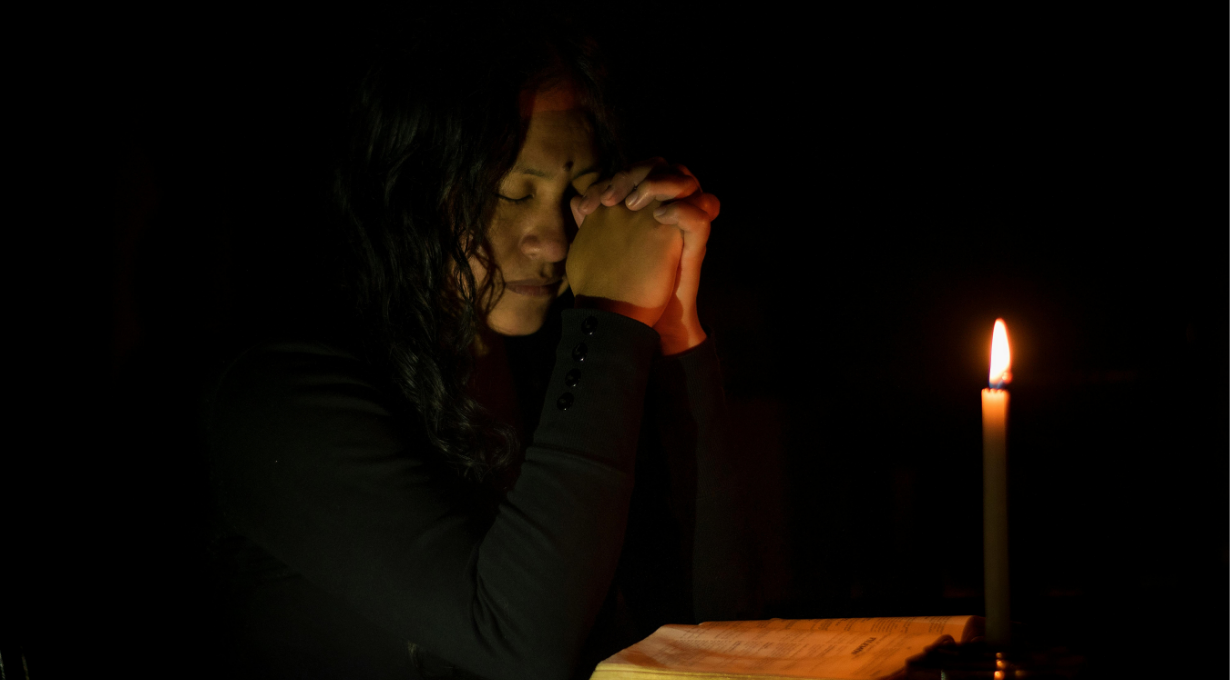
Nighttime has a way of catching you mid-sentence. You’ve been moving all day answering things, managing things, being fine, and then the house goes quiet, and suddenly everything you’d been outrunning is just sitting there waiting. The worry you shelved at 9 am. The conversation you replayed twice and then forced yourself to stop. The good thing that happened that you rushed past without actually feeling. That’s probably why night prayers have existed across every tradition and every century. It’s not that people become more spiritual after dark. It’s that the usual escapes stop working quite as well. The busyness runs out. Some people grab their phones. Some people pray. Both of those are reaching for something — one just goes a little deeper.
This isn’t about doing it right. It’s just about doing it.
Why Praying at Night Hits Different Than Morning Prayer
Morning prayer is asking for what you’ll need. Night prayer is doing something with what actually happened. Those are genuinely different exercises.
Psalm 4:4 says, “Search your hearts and be silent.” That’s nearly impossible at 9 am with a to-do list running in the background. At night, with nothing urgent left on the calendar, it’s at least possible.
Psalm 119:148 describes the psalmist awake in the night, turning over God’s promises. There’s no crisis in the verse. No insomnia or dread. Just someone who found the quiet hours useful for a particular kind of attention. Most people who pray regularly know exactly what that feels like.
What Night Prayers Are Actually For
Honestly, different things on different nights. Some nights you’re praying because you’re grateful and you know it’ll slip away if you don’t stop and name it. Some nights, something is sitting on your chest, and you can’t shift it, and you just need somewhere to put it. While Some nights it’s less of a prayer and more of a check-in — not really asking for anything, just not ending the day without acknowledging that God is there.
None of those is the correct version. What they have in common is that you did it. You closed the day with something deliberate instead of just passing out mid-sentence.
If you’ve been in a rough stretch for a while — the kind where the nights are the hardest part because there’s nothing left to distract you — the prayers for strength piece is written for exactly that. Not the composed version of asking for help. The real version.
Night Prayers You Can Use Right Now
Say these however they come out. Change the words if they don’t fit where you actually are.
When you’re grateful but exhausted
Lord, today was a lot. Most of it was good, and I know that — I’m not taking it for granted. I’m running on empty and I know it. But today had good things in it — people, small moments, things I almost blew past without noticing. I’m glad they were there. Let me rest tonight and wake up with enough left to show up again tomorrow. Amen.
When the day was genuinely rough
God, today was genuinely rough and I’m not through it yet. I’m not going to pretend otherwise. I’m not asking for resolution or a reason — I just can’t carry this into sleep with me. Hold it for a few hours. I’ll come back to it. Amen.
When anxiety keeps looping
Father, I’ve been lying here going in circles. Same worry, same loop, same place I started. I know I can’t think my way out of this tonight — I’ve been trying. So I’m handing it over. I don’t have to solve it at midnight. Let me rest. Amen.
When you need to let go of the day’s regrets
Lord, I got a few things wrong today. Not catastrophically — just the quiet kind of wrong that sits with you. A thing I said that landed badly. A moment I opted out of when I should’ve stayed. I know where I fell short. But I also know you’re not keeping a score that I have to balance before I sleep. Help me learn from what needs learning. And let the rest go. Amen.
When you’re praying for someone else
God, [name] is on my heart tonight. I don’t know exactly what they’re going through — or I do know and I don’t know how to fix it, which is worse. I can’t be with them right now but you can. Be with them in their night, whatever it looks like. Give them enough peace to sleep and enough of you when they wake up. Amen.
When you have nothing left to say
God. I’m here. You know the rest. Amen.
What the Bible Actually Says About Night Prayers
It’s in there more than most people realize, and it’s not all Psalms.
Daniel prayed three times a day as a regular habit — not a crisis response, just the structure of how he lived. When that habit was threatened with a death penalty, he kept doing it anyway. That’s what a consistent night prayer practice actually looks like. Not dramatic. Not emotional every time. Just reliable.
Psalm 63:6 is just a person lying awake, turning their thoughts toward God. No emergency prompted it. The night got quiet, and that’s where their mind went. Some people still pray exactly like that — no words, no structure, just attention pointed somewhere. That’s not a lesser version of prayer. It might be the oldest version.
In Luke 6:12, Jesus spent the whole night in prayer before naming his twelve disciples. He didn’t rush it or fit it into a busy morning. The night was what the decision needed — the hours, the quiet, the time away from anyone else’s opinion. He came out of it knowing what to do.
And 1 Thessalonians 5:17 — “pray without ceasing” — used to feel like an unreasonable bar. But Paul means something closer to: keep the line open. Don’t treat prayer as a scheduled event you attend and then leave. The night prayer isn’t a separate appointment. It’s just the conversation continuing.
Night Prayers for Specific Situations
When you can’t sleep
Lord, I’ve been lying here a while. I’m not going to pretend I’m okay with that — I’m tired and frustrated, and I wish my mind would just stop. But you’re here, even in this. Help me stop fighting it so hard. If I sleep, good. If not, let this be time with you instead of just frustration in the dark. Amen.
Psalm 127:2 is worth holding here: “He grants sleep to those he loves.” Not a guarantee of eight hours, but a reminder that rest is something God wants for you — you don’t have to earn it or wrestle your way into it.
When grief is worst at night
It gets bigger after dark. The house is quiet, there’s nothing to occupy you, and whoever’s missing fills the whole space in a way that doesn’t happen during a busy afternoon. There’s no prayer that makes that not true.
But there’s Psalm 34:18: “The Lord is close to the brokenhearted and saves those who are crushed in spirit.” Not fixes. Not solves. Close.
God, nighttime is the hardest. Everything goes quiet, and [name] should be here, and they’re not. I’m not asking you to take this away — I think I need to feel it, and I think that’s okay. I just need to not feel alone inside it. Be close. That’s all. Amen.
If you’re praying through illness — yours or someone else’s — the prayers for healing piece is written for the long middle stretch of that, not just the emergency at the beginning.
When you’re worried about tomorrow
Father, tomorrow is sitting on my chest tonight. I know what’s coming and I’m dreading it — or I don’t know and somehow that’s worse. I’m not asking you to tell me how it ends. I know that’s not usually how this works. I’m just asking for enough to walk into it without falling apart first. Take tomorrow. I trust you with it even when I can’t feel that trust right now. Amen.
Philippians 4:6–7 has been on enough coffee mugs that it’s easy to stop actually reading it. But look at what it’s actually promising — not that God removes the problem, not that the anxiety disappears cleanly, but that something stands guard over your heart and mind while the problem is still there. The peace comes alongside the hard thing, not after it. That’s a different kind of comfort than most people are expecting when they first read it.
For nights when the problem isn’t anxiety but genuine uncertainty — you’re not spiraling, you just don’t know what to do — the prayer for guidance piece is more directly useful than this one.
Night Prayers for Couples and Families
Praying together at night is one of the simplest habits in a marriage and one of the most skipped. Not a long devotion, not a structured program, just a few honest sentences before you both fall asleep. Research from organizations like the National Marriage Project consistently shows that couples who pray together report significantly higher relationship satisfaction. That’s not a small finding.
It doesn’t need to be formal. It can sound like this:
God, thank you for today. Thank you for [name]. Help us be good to each other and patient with each other. Cover what we can’t cover on our own. Amen.
If you want to go deeper on praying specifically for your marriage, not just alongside each other but for the relationship itself, the prayer for marriage piece is worth the read.
For families with kids, praying at night gives children something that’s hard to replicate elsewhere: the experience of a parent being actually honest with God in front of them. Not performing religion. Doing it. That sticks differently than formal religious instruction ever does.
How to Actually Build the Habit
The thing that stops most people isn’t doubt or disinterest. They fall asleep mid-scroll, or feel too tired to do it properly, or keep waiting for a night when they’re finally in the right headspace.
That night doesn’t come. You go in tired or not at all.
Tie it to something you already do every single night, brushing your teeth, putting your phone on the charger. The moment your phone is down, that’s when you pray. Not before it’s down, because the phone always wins. After.
Keep it short as the default. A two-minute prayer that actually happens every night is worth more than a twenty-minute prayer you talked yourself into twice this week and skipped the other five. Start small. Let it grow on its own.
Write it down sometimes. Not as a performance, just occasionally, when something is genuinely weighing on you. Looking back at what you were praying six months ago, and seeing what happened on the other side of it, is one of the most quietly faith-building things a person can do.
Pray.com has guided night prayers and sleep-focused content that genuinely helps people who don’t know where to start. Worth trying if blank silence is the thing that makes you skip it.
When Night Prayers Feel Like Nothing
There are seasons when you say the words, and there’s just no feeling attached to them. No warmth, no peace, no sense that anyone’s listening. You do it anyway, and it feels like talking into a wall.
That’s not evidence, it’s broken. That’s just what a dry season feels like, and it happens to everyone who prays long enough.
Hebrews 11:1 doesn’t define faith as a feeling. It says faith is “confidence in what we hope for and assurance about what we do not see.” The showing up is the act of faith. The emotion is optional.
Psalm 77:1–2 is worth reading on those flat nights: “I cried out to God for help; I cried out to God to hear me. When I was in distress, I sought the Lord.” The psalmist doesn’t say they felt better. Just that they kept crying out. That’s the whole model.
Keep going. Don’t adjust the prayer based on whether it feels like anything. Faithfulness in the hollow seasons is a different kind of prayer — not less real, just quieter.
One More Prayer
If you came here tonight looking for something to say and nothing in here quite fits:
God, I don’t know how to close today. Some of it was fine and some of it wasn’t and I’m still sort of in the middle of all of it. I’m not performing this — I’m just here, bringing whatever this actually is. Thank you for the day. Watch over everything I can’t watch over. I’m yours. Amen.
Put the phone down. That’s enough.