Say “Hail Mary Prayer” to almost any Catholic and watch what happens. The rest just falls out of them, no thinking required, the same way your own phone number does when someone asks for it too fast. Most of us picked it up exactly like that. Kneeling next to a parent. Counting beads in a pew while the priest carried the words for us so we didn’t have to know them yet. Nothing strange about that, it’s just how Catholic kids learn it. What’s a little stranger is that this is one of the oldest prayers in Christian history. And most people who say it every single week couldn’t tell you where a single line actually came from.
It’s not just a string of syllables you rattle off between decades on the rosary, though. Nearly the whole prayer is built out of Scripture, stitched together over a few hundred years by people who wanted a short, honest way of asking Mary to pray alongside them. Once you know where the lines came from, the whole thing stops feeling like background noise. It starts feeling like it has a spine.
What Is the Hail Mary Prayer, Really
Strip away the Latin and the church history and what’s left is a request. That’s it, nothing fancier. Catholics aren’t worshipping Mary here — worship in that sense belongs to God alone, no exceptions, full stop. What’s actually happening is you’re asking her for something, more or less the way you’d ask a friend, or your own grandmother, to keep you in her prayers. The first half is praise. The second half is the ask, and it’s aimed at two very specific moments: right now, whatever today happens to look like, and later, whenever your death actually shows up.
Praise first, then the plea. Takes about fifteen seconds, and nobody alive can point to the person who sat down and wrote it.
Where the Ave Maria Prayer Comes From
Ave Maria is just Latin for the same two opening words “Hail Mary” in English and Latin happened to be the language the Western Church prayed in for most of its history. Which is why that name stuck around in so many old hymnals and prayer books. Almost every phrase that follows traces straight back to Luke’s Gospel. And honestly, that surprises people who’ve said this prayer their whole lives without ever cracking open the source.
Take the opening line. “Hail Mary, full of grace, the Lord is with thee” is close to word-for-word what the angel Gabriel says to Mary during the Annunciation. A few verses later, Mary’s cousin Elizabeth greets her at the door still pregnant herself. Probably still catching her breath from the shock of it — and says almost exactly “blessed art thou among women, and blessed is the fruit of thy womb.” Nobody at the Vatican dreamed that greeting up. Two women said those two things on two different days in Scripture, and somewhere along the way somebody noticed the lines belonged next to each other.
The back half took a lot longer to settle. “Holy Mary, Mother of God, pray for us sinners, now and at the hour of our death” turns up in rough form in devotional writing as far back as the eleventh century. But nobody pinned the wording down for good until the Catechism of the Council of Trent, written in the 1500s. So the version most of us say today took over a thousand years just to get finished.
The Full Text of the Hail Mary Catholic Prayer
This is the version most Catholics grow up with, word for word:
Hail Mary, full of grace, the Lord is with thee. Blessed art thou among women, and blessed is the fruit of thy womb, Jesus. Holy Mary, Mother of God, pray for us sinners, now and at the hour of our death. Amen.
That’s the whole prayer. No secret longer version tucked away for a stricter crowd, whatever some people online will tell you. The USCCB publishes this exact wording, and it’s what you’ll hear at Mass, at the rosary, or muttered under someone’s breath in a hospital hallway by a person who isn’t even sure anymore if they believe.
Breaking Down the Words Line by Line
Start with “full of grace,” since most people rush right past it. In the original Greek, Gabriel’s word points at something already finished not “grace is on its way” but “you’re already filled up with it.” Catholic teaching ties that back to Mary’s unique preparation for carrying Jesus, and it’s part of what sits underneath the doctrine of the Immaculate Conception.

Then “the Lord is with thee,” present tense, on purpose. Not a future promise, not “he’ll show up eventually.” Gabriel is standing there naming something that’s already true in the room while he says it.
“Blessed art thou among women” comes straight from Elizabeth, still catching her breath over finding out she’s pregnant at an age she figured that door had closed for good. She never actually said the word “Jesus,” though. That got added later, once the Church tacked his name onto the end of her greeting so the line pointed somewhere specific instead of trailing off into nothing.
Then the whole tone shifts. You stop praising Mary and start asking her for something. “Holy Mary, Mother of God” isn’t a compliment — it’s a title, and it came out of a real fight at the Council of Ephesus in 431, where bishops argued over whether Mary could rightly be called mother of God, or only mother of the human side of Jesus. They landed on the first one, and the title’s held ever since.
“Pray for us sinners, now and at the hour of our death” is the actual request buried underneath all of this. Two moments, chosen on purpose. Today, whatever it looks like. And later, at the one appointment none of us gets to sit for twice.
How the Hail Mary Fits Into the Rosary
Most people run into this prayer for the first time through the rosary, repeated ten times inside every decade, sandwiched between an Our Father on one side and a Glory Be on the other. If you’ve ever wondered why the Lord’s Prayer sits right next to it — that’s why. The rosary was built specifically to braid the two together, one going straight to the Father, the other handing the same request over to Mary.
Ten in a row sounds like a lot until you actually sit down and try it. Somewhere around the fourth or fifth repeat, something shifts. You stop translating the words in your head and they just start sitting there, and that’s usually the moment a specific worry, or a name you’d been avoiding, floats up on its own. The repetition isn’t meant to wear the words down — it’s meant to wear down whatever’s been standing between you and actually meaning them.
Why This Catholic Prayer Splits Christians Down the Middle
Bring this prayer up with a Protestant friend and you’ll probably get a raised eyebrow, maybe a quiet change of subject. Most Protestant churches skip it entirely, and the real disagreement was never really about the wording. It comes down to whether it’s okay to ask someone who’s already died to pray on your behalf, or whether that request belongs to God and nobody else.
Catholics usually answer that by scaling it down to something ordinary. You ask a friend to pray for you all the time, and nobody thinks that competes with praying to God directly — it’s just one more voice added to the pile. The Catholic position holds that death doesn’t cancel a person’s ability to keep praying for someone else, so asking Mary works the same way as asking a neighbor, just at a different address. Plenty of people land somewhere else on that question, and fair enough — it’s one of the older, more honest disagreements in Christian practice, not something either side should wave off in a sentence.
When Catholics Actually Pray It
Outside the rosary, this prayer turns up wherever a short, honest word feels necessary. Before a hard conversation. Sitting in a hospital hallway. Right before an exam nobody feels ready for. Some people build it into their daily prayer routine, saying it once in the morning like a kind of handoff before the day really gets going, and again at night once things have quieted down enough to notice what actually needs praying about.
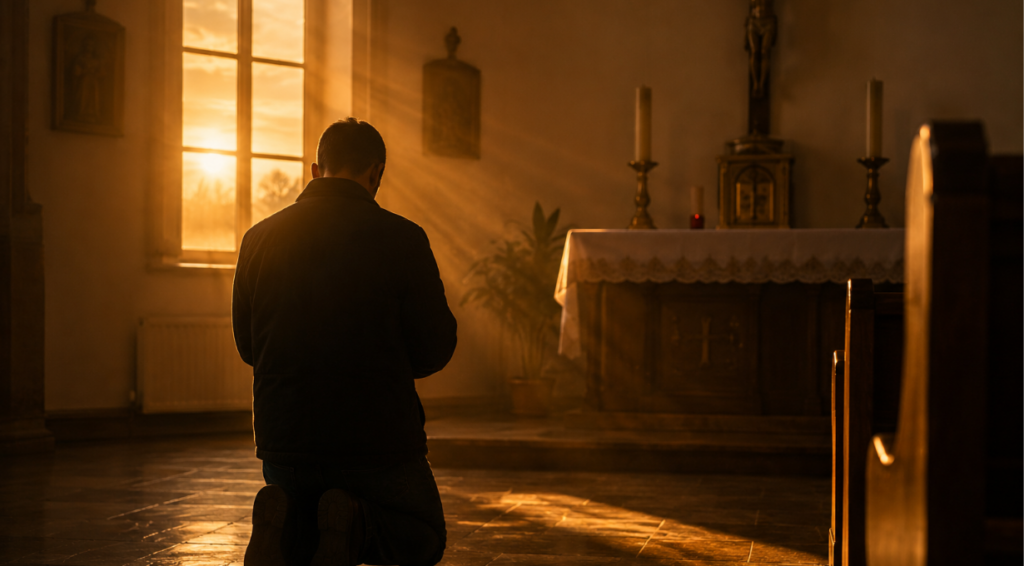
It travels well too, and that’s probably a big part of why it’s lasted this long. You can say it in a car with the radio off, in a waiting room, walking toward a door you’d rather not knock on. A prayer that only works sitting still in silence tends to get left behind somewhere along the way. This one was never built for that.
How to Pray the Hail Mary With Real Attention
Try saying it slowly once, out loud if you can manage it without feeling silly. Stop after “full of grace” and actually sit with what that phrase is claiming about her. Stop again after “blessed is the fruit of thy womb, Jesus” and notice that even though Mary’s the one you’re addressing, the whole first half of the prayer is really pointing at him.
Slow down even more for the last line. “Now and at the hour of our death” is asking for two completely different kinds of help on two completely different timelines, packed into a single breath. Most people rush that line faster than any other part of the prayer. Might be worth being the one who doesn’t.
If the words start feeling a little worn out from saying them too many times, that’s not unusual, and it doesn’t mean you’re doing anything wrong. It happens just as often to someone who’s said this prayer daily for fifty years as it does to someone praying it for the first time this week. When that happens, it can help to remember this is a Catholic prayer built for repetition, not novelty. Nobody expected you to feel something brand new every single time you said it. The point was always just to keep asking.
A Simple Way to Start
You don’t need a rosary in your hand to say this prayer, though it helps some people keep count while they go. Just say it once, slowly, and notice which line catches somewhere in your chest. That’s really the whole practice. Not getting through it — just meaning it while you go.
Gabriel showed up with a greeting nobody in that house was expecting, and people have been handing pieces of it back and forth ever since, in Latin, in English, in a hundred other languages. It still works the same way now as it did the first time somebody strung those lines together.
FAQ: Hail Mary Prayer Questions People Actually Ask
Is the Hail Mary prayer only for Catholics?
Mostly, though you’ll also find it in Eastern Orthodox devotion and some Anglican practice. Nothing stops anyone else from praying it. Most Protestants simply choose not to, since asking anyone besides God to intercede runs against a lot of Protestant theology.
What is the difference between the Hail Mary and the Ave Maria?
Honestly, none. Ave Maria is just the Latin name for the same prayer, lifted from its first two words. You’ll also hear the name attached to a piece of music now and then, since both Schubert and Gounod wrote well-known settings of the Latin text, but the prayer underneath is identical either way.
How many times is the Hail Mary said in a rosary?
Fifty times across a full five decades — ten within each decade, bracketed by an Our Father before and a Glory Be after.
Do you have to be Catholic to say the Hail Mary prayer?
Not at all. There’s no membership card required to say a sentence out loud. Plenty of people outside the Catholic Church have picked it up simply because the words themselves felt worth praying.
Where does the second half of the prayer come from if it isn’t in the Bible?
That part came later, out of Catholic devotional life, and didn’t get locked into its current wording until the Catechism of the Council of Trent back in the sixteenth century. The first half comes almost straight out of Luke’s Gospel. The second half is the Church’s own addition, asking Mary to step in and pray.
Can non-Catholics pray the rosary?
Yes, and some do. A number of Anglican and Lutheran Christians keep versions of the practice going, even though it’s most closely tied to Catholic tradition.