
Ask ten people what “prayer times” means. You’ll get ten different answers. It depends on their faith. It depends on their upbringing. Sometimes it just depends on what they watched their parents do before dinner. For over a billion Muslims worldwide, it means five fixed windows tied to the sun’s position. For Christians, it’s often looser. A morning moment. A grace before meals. A quiet minute before bed. Different shapes, same idea underneath. Prayer works better with a schedule attached to it.
This guide breaks down what prayer times actually mean. It covers how the five daily Islamic prayers are structured. It also looks at how Christians have kept their own rhythm of prayer alive for centuries. Maybe you’re trying to understand Salah times for the first time. Maybe you just want more consistency in your own prayer life. Either way, you’ll find something useful here.
What Are Prayer Times, Exactly?

Prayer times are the specific windows set aside for worship each day. In Islam, these times are fixed by the sun’s position. They repeat daily, without exception. In Christianity, things are less rigid. But the tradition runs just as deep. The Liturgy of the Hours has guided monks and clergy through set prayer times since the early church.
Both traditions share one belief. Prayer shouldn’t be an afterthought. It shouldn’t get squeezed in only when convenient. It needs an actual place on the calendar. Give prayer a fixed time, and it turns into a habit. Leave it loose, and it stays a hope you never quite get to.
Islamic Prayer Times: The Five Daily Prayers
Salah is the Arabic term for the formal Muslim prayer. It happens five times a day. These aren’t optional check-ins, either. They’re obligatory for every adult Muslim. Each prayer falls within its own window, tied to the sun’s movement across the sky. Here’s how the five daily prayer times break down.
Fajr
Fajr opens the day. It starts at the first sign of true dawn, that thin band of light on the horizon. It ends right before sunrise. A lot of Muslims call this the hardest prayer to keep consistently. Waking up before the rest of the world isn’t easy. That’s kind of the point, though. Starting the day in worship, before anything else competes for your attention, sets a tone. It’s hard to replicate that tone later in the day.
Dhuhr
Dhuhr lands at midday. It begins once the sun passes its highest point and starts declining west. It’s the second prayer of the day. It usually falls in early afternoon, right in the middle of work or school. For a lot of people, this is the trickiest one to plan around. Finding a quiet corner in an office isn’t always simple.
Asr
Asr comes next, in the mid-to-late afternoon. Classical Islamic timekeeping ties its start to shadow length. Once a shadow matches the height of the object casting it, the window opens. It closes as the sun starts turning yellowish, just before sunset. A lot of people treat Asr as a reset point. It’s a small pause before the evening rush takes over.
Maghrib
Maghrib begins right at sunset. Its window is one of the shortest of all five prayers. Because of that, most Muslims pray it as soon as it starts. Nobody wants it slipping into dinner prep or errands. There’s something fitting about the timing, honestly. The day is ending. The light is fading. This becomes a quiet thank-you for making it through.
Isha
Isha closes out the day. It begins once twilight fully fades. It can technically be prayed anytime until midnight. Still, many people choose to pray it before bed. It’s the last checkpoint of the day. A moment to reflect. A moment to ask forgiveness. And a moment to settle down before sleep.
How These Prayer Times Are Calculated
A clock reads the same everywhere. These don’t work that way. They shift by location, by date, and even by the calculation method a mosque follows. Since Salah times track the sun, someone in Jakarta and someone in Toronto will never share an identical schedule. Latitude matters. Longitude matters. Local sunrise and sunset times matter too.
Several calculation conventions exist as well. Muslim World League. Islamic Society of North America (ISNA). Umm al-Qura. A handful of regional variations, too. They differ slightly in how they define dawn and the Isha window. That’s exactly why most Muslims skip the manual math. They lean on a trusted local mosque schedule instead, or a verified app. For a reliable source, IslamicFinder publishes location-based prayer schedules. It accounts for these calculation differences automatically.
Why Fixed Prayer Times Matter
There’s a reason both Islam and Christianity built structure around prayer. Neither left it to whenever people felt like it. Left unscheduled, prayer gets pushed aside fast. Something else always feels more urgent. An email. A meeting. A kid who needs picking up. A fixed time removes that negotiation entirely. You don’t decide whether to pray. The clock decides for you.
There’s a rhythm benefit too, beyond just discipline. Five prayers spread across a day break it into pieces. Morning, midday, afternoon, evening, night. Each one is a small return to center. Then the next stretch of the day pulls you back in.
Christian Prayer Times: Praying Through the Day
Christianity doesn’t run on a single universal prayer schedule. Not the way Islam does. But the instinct to structure the day around it runs just as deep. Monastic communities have followed the Liturgy of the Hours for over a thousand years. They prayed at set points, from before dawn until night. A lot of Christians today keep a simpler version of that same habit alive.
Morning prayer tends to anchor the day. It happens before the noise sets in, before phones and to-do lists take over. If you’re building that habit, our guide on praying for morning walks through what to actually say to God before the day gets loud. Grace before meals works as another built-in checkpoint.
Set prayer times aren’t about rigid rule-following, in either tradition. They’re about making sure faith doesn’t get crowded out. Everything else in life is competing for your attention. It needs its own protected slot.
Building Your Own Schedule
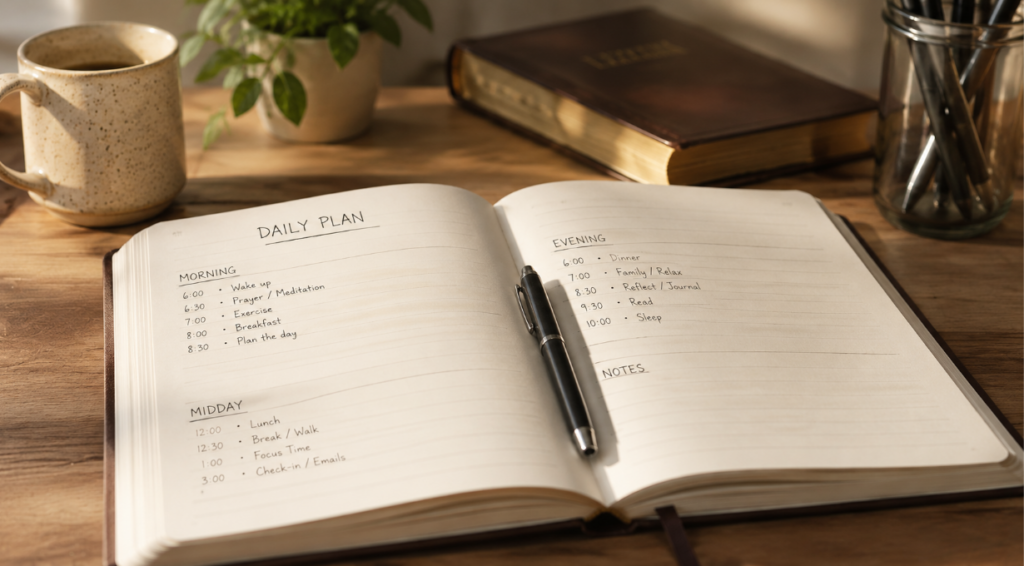
You don’t need five daily windows for this. You don’t need a monastic calendar either. Start small. Pick one fixed point. Morning, right before bed, before dinner, whatever fits your life. Hold that time steady for a couple of weeks. Then add another one, if it feels right.
Consistency beats ambition here, every time. A five-minute prayer at the same time daily adds up. It’ll do more for your faith than an hour you keep meaning to get to. That hour rarely comes, if we’re honest.
If safety is weighing on you during a particular season, tie a prayer to your morning routine. Our prayer for protection is written for exactly that kind of daily grounding. Traveling soon? Try tying a short prayer to your departure time instead. Think of it like Muslims tying Maghrib to sunset. A fixed moment, easy to remember. Prayer for safe travel works well for that.
Frequently Asked Questions
How many prayer times are there in a day?
Islam has five fixed daily prayer times. They’re Fajr, Dhuhr, Asr, Maghrib, and Isha. Christianity doesn’t mandate a fixed number. Traditional practices like the Liturgy of the Hours can include up to seven set points to pray.
Do prayer times change by location?
Yes, they do. Islamic times are calculated from the sun’s position. They shift based on latitude, longitude, and the date. Cities near the equator see fairly steady windows year-round. Cities farther north or south notice bigger swings between summer and winter.
What is the difference between Fajr and Isha prayer times?
Fajr is the first prayer of the day. It’s prayed at dawn, before sunrise. Isha is the last one. It’s prayed after twilight fades, lasting until midnight. Together, they bookend the day’s five prayers.
Can we pray late?
In Islam, each prayer has a specific window. Praying outside that window is generally discouraged without a valid reason, like illness or travel. Still, making up a missed prayer beats skipping it entirely. Christian prayer doesn’t work the same way. A missed morning prayer can simply be picked up later.
Why do Muslims pray at specific times instead of whenever they want?
Fixed prayer times build discipline. They keep worship consistent, instead of leaving it to mood or convenience. Fixed times also make communal prayer possible. A whole community can gather at the mosque during the same window.
Is there a Christian equivalent to Islamic times?
Not an exact one, no. But the idea shows up in different forms. The Liturgy of the Hours in Catholic and Orthodox tradition. Morning and evening devotionals in Protestant practice. Simple habits like praying before meals or before bed. The goal underneath is the same. Keep prayer anchored to specific moments. Don’t let it slip away entirely.
Prayer times exist for one simple reason, no matter the tradition behind them. Faith holds up better with structure around it. That structure might look like five calls to prayer a day. Or it might be one quiet minute before your feet hit the floor each morning. The schedule isn’t really the point. It’s just what makes sure the prayer actually happens.